Israel's Knesset Election: A Stalemate Looms as Netanyahu Battles the Change Bloc
Polls indicate no majority will emerge in Tuesday's vote, leaving the outcome dependent on Arab turnout and new parties challenging ultra-Orthodox draft exemptions.
By Brandon Hayes ·
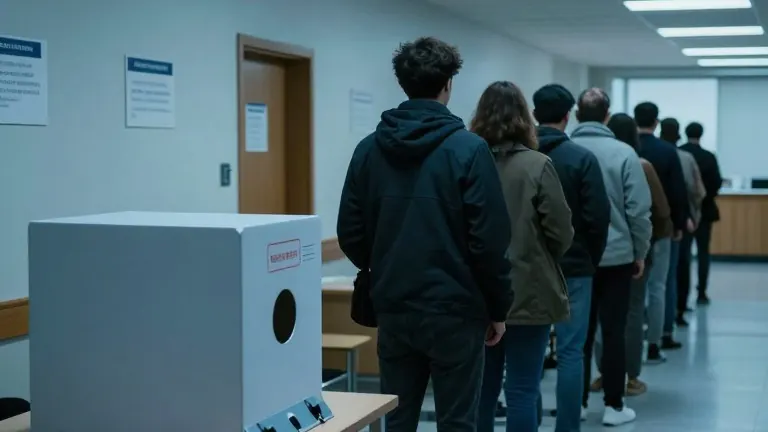
Voters in Israel face a binary choice on Tuesday that may not resolve the country's political direction for weeks. With no clear path to a majority in the 120-seat Knesset, the election risks producing a government formed through fragile backroom deals rather than a decisive mandate.
Prime Minister Benjamin Netanyahu leads the right-wing and religious bloc. His coalition relies on partnerships with ultranationalist and Jewish religious parties. He argues that only he can govern without the support of Arab parties, which he views as a security risk. His second argument is that the wars in Gaza, Lebanon, and against Iran are unfinished and require his continued leadership to conclude.
President Donald Trump endorsed Netanyahu last week, warning that the United States might have to handle the Iran conflict alone if Israel elects a different leader. Trump stated that if Israel has the wrong leader, America will have to do the work itself, and he is not inclined to do so. Netanyahu has used this endorsement to claim that only he can ensure Iran does not obtain a nuclear weapon.
The opposition, known as the change bloc, consists of a diverse group of Arab, right, left, and center parties united by the goal of removing Netanyahu from power. The leading figure in this bloc is Gadi Eisenkot, a former military chief who leads the centrist Yashar party. Eisenkot lost his son and two nephews in the Gaza war. He frames his campaign around national unity and accountability, promising a state inquiry into the intelligence failures that led to the October 7, 2023, attacks. Netanyahu has blocked such an inquiry in the past.
Eisenkot criticized Netanyahu's recent campaign tactics, which included an AI-generated image of a mushroom cloud over Tel Aviv. Eisenkot accused the Prime Minister of relying on fear-mongering and threats. He noted that while Netanyahu presents a binary choice between the right wing and a nuclear bomb, his own party offers a third path.
The election outcome may hinge on voter turnout, particularly among Arab Israelis who make up about 20% of the population. Analysts at the Israel Democracy Institute note that Arab turnout has historically been volatile. Jehad Abomoch, a cafe owner in Baqa al Gharbiya, said many Arab Israelis feel they have no hope or future under the current government. He expects high turnout to prevent Netanyahu from forming another government with far-right allies.
Two new parties are also entering the race, each hovering near the threshold required to win a Knesset seat. Both parties are challenging Netanyahu's alliance with ultra-Orthodox groups by demanding that they participate in mandatory military service. If either party crosses the threshold, it could tip the balance of power, either helping Netanyahu form a coalition or giving the change bloc a plurality.
If neither side wins a clear majority, the country faces several possible paths. Lawmakers could break campaign promises and switch sides, a common occurrence in Israeli politics. Alternatively, the change bloc could attempt to form a minority government by securing more seats than the opposition, even if less than 50% of the total. Arab parties could support or abstain from voting against such a government. If all negotiations fail, Israel will hold new elections, a scenario that occurred five times between 2019 and 2022.
Source: CBS News